Showing posts with label Travel. Show all posts
Voyages Afrique de l'Ouest: La Finala, Senegal
0Monday, 5 May 2014 by Renee
Our final adventure in Francophone West Africa was Senegal, notably the first French colony in West Africa. In between coming home from Benin and heading off again, we had a couple of weeks back in Accra, in which my lovely friend came to visit, I got really really sick and spent the best best part of three days being mislead around a hospital waiting for the right appointments, had a great (though sickly) time down in a coastal fishing village with our friends, finished a large proposal at work, spent more time at the hospital and tried frantically to find out why we still didn't have a visa for Senegal - it frequently seemed like we would never get there (you might recall the difficulties getting the flights in the first place).
I spent the day of our evening flight juggling work with phone calls from my medical insurance crew. Having made the terrible mistake of asking my insurance for advice ("just to check I'm on the right medication to finally deal with this ear problem before I fly to Dakar" - never again!), I had to spend days trying to get a medical report to confirm my ears were ok for flying - the Ghanaian/bureaucratic equivalent of herding cats who themselves are looking for needles in haystacks. Meanwhile, Adam was in charge of working out what on earth had happened to our visas, which had fallen victim to a new online biometric visa system, and trying to work out what the punishment is for unauthorized entry to Senegal. This included trying to locate the rather mysterious Senegalese Embassy which in Ghana is not done by phone or internet but by taxi and a general sense of smell and feel, while I tried to see how much it would cost to cancel or postpone our flights, also not an easy task in Ghana. Being Eid, when Adam finally found the embassy no one was there except a guy hanging around the gate claiming to be a visa officer (or gardener? or security?) who informed Adam they were having lots of problems with the new online visa system, so as long as we had the first email, it was fine if we still hadn't received the confirmation. That was enough reassurance for us - we were off to Senegal.
Despite this, our 1am arrival was completely uneventful right through to waking up to finding that this was the view from the rooftop of our guesthouse! We stayed at the lovely Auberge Keur Diame in the beachside suburb of Yoff, run by a Swiss lady Ruth and friendly Senegalese manager Ibra. We'd definitely recommend it with just one caveat - the courtyard is in the interior with rooms around it on each level, and as there are no windows on the outside, the lack of airflow is not the greatest design for Dakar's oppressive heat (there are fans but no a/c). When we were there it was even hotter than Accra, which we thought was impossible but obviously not.

I'm a sucker for always trying to jam pack way too much into holidays, but we made a deliberate decision to slow the pace down on this holiday and try to rest and enjoy a couple of towns well rather than a new spot every second night. We spent our first lazy morning kicking back on the rooftop, and then ventured out for an afternoon stroll around the nearby streets.

Things get quiet in the afternoon during Mosque/siesta, but then we noticed these little yoghurt shops opening up and couldn't help ourselves - delicious!
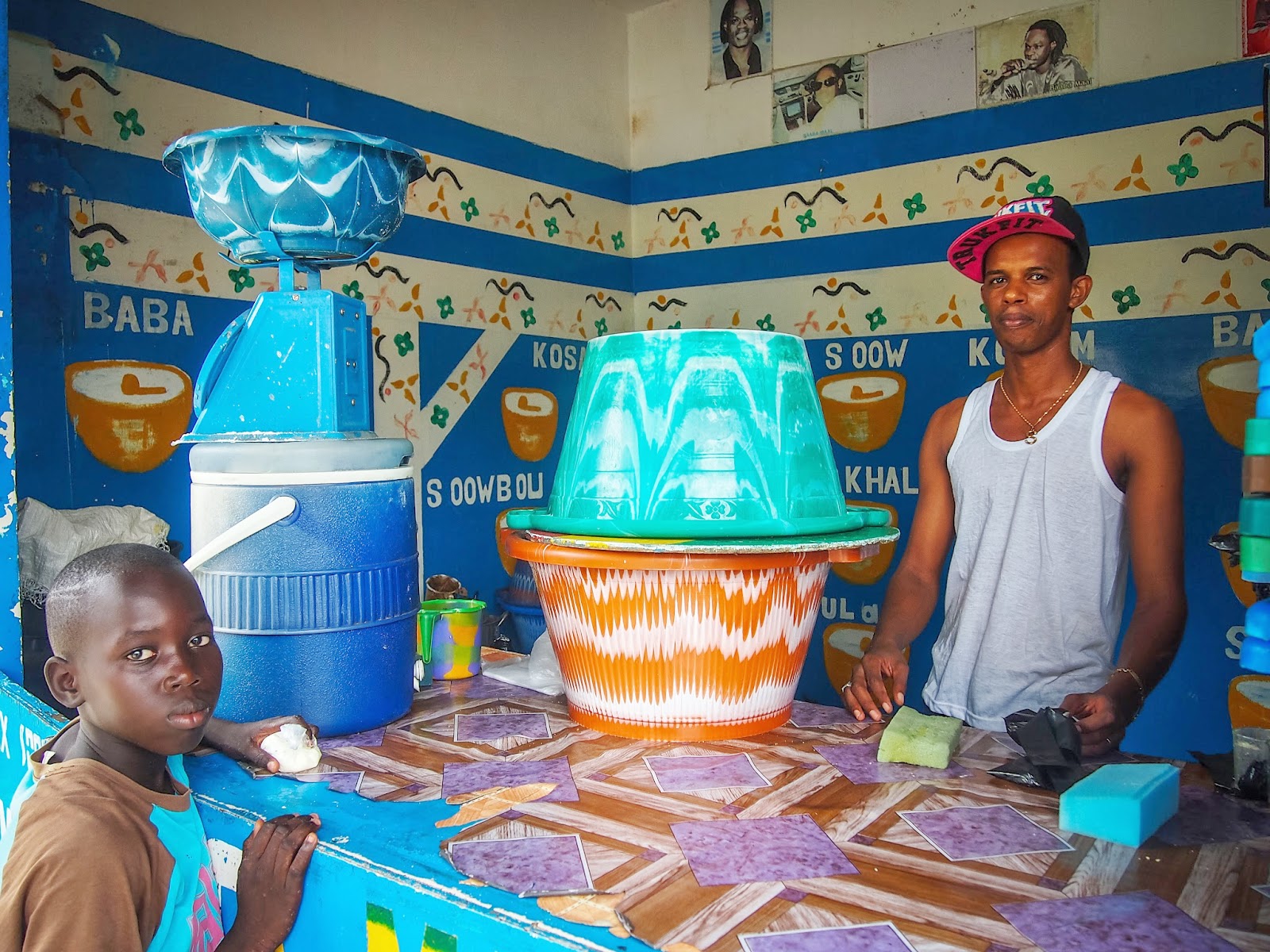

(Most Senegalese people are Muslim, and most of follow Sufi orders of the Mourides. Throughout Senegal you can find different versions of this mural of Amadou Bamba, founder of the Mouride Brotherhood, and his disciple Ibra Fall.)
People had warned us that Dakar is a crazy and intense city, but I'm not sure if those warnings were given with the fact that we were already living in Accra in mind; comparatively, Dakar seemed fairly tame. We were there in the thick of Eid though, and we were told most Dakar residents head to their home villages over the holiday period, so we may not have gotten a typical experience of the capital.
When we wandered into the CBD of Dakar, we were taken aback by how developed it seemed. By many measures, Senegal is much poorer than Ghana (Senegal's Human Development Index is 154, compared to Ghana's 134 or Australia's 2) yet here were paved roads, proper gutters, things just seemed cleaner and more functional - hell we even found hot showers at our guesthouse! But those things a fairly rough measures of poverty - that there is hot water on tap in a tourist guesthouse doesn't mean much for the vast majority. When we noted there seemed to be far fewer slums and informal buildings than in Accra, we were told that's actually just because the Senegalese government knocks them down quicker. As a result, tiny apartments are often shared between 30 or so family members who take shifts over the day/night to use the facilities or sleep. Looks can be deceiving, right? Just like the impressive Dakar train station at the end of the line to Bamako, Mali, which stopped running in about 2003.


We spent another day exploring Ile de Goree, a fascinating and stunning island near Dakar's port, which was used as an administrative post of the French (and occasionally other colonisers when they stole it with one treaty or another). It is littered with elegant French colonial buildings and exudes a serene atmosphere, but also is home to the House of the Slaves and other museums to the Transatlantic Slave Trade. It's actual role in the trade is somewhat controversial - some say only a handful of slaves actually passed through. Nonetheless, the French-ness of it all makes it quite conducive to meditating on what life must have been like for Senegaese under the French during the slave trade years.

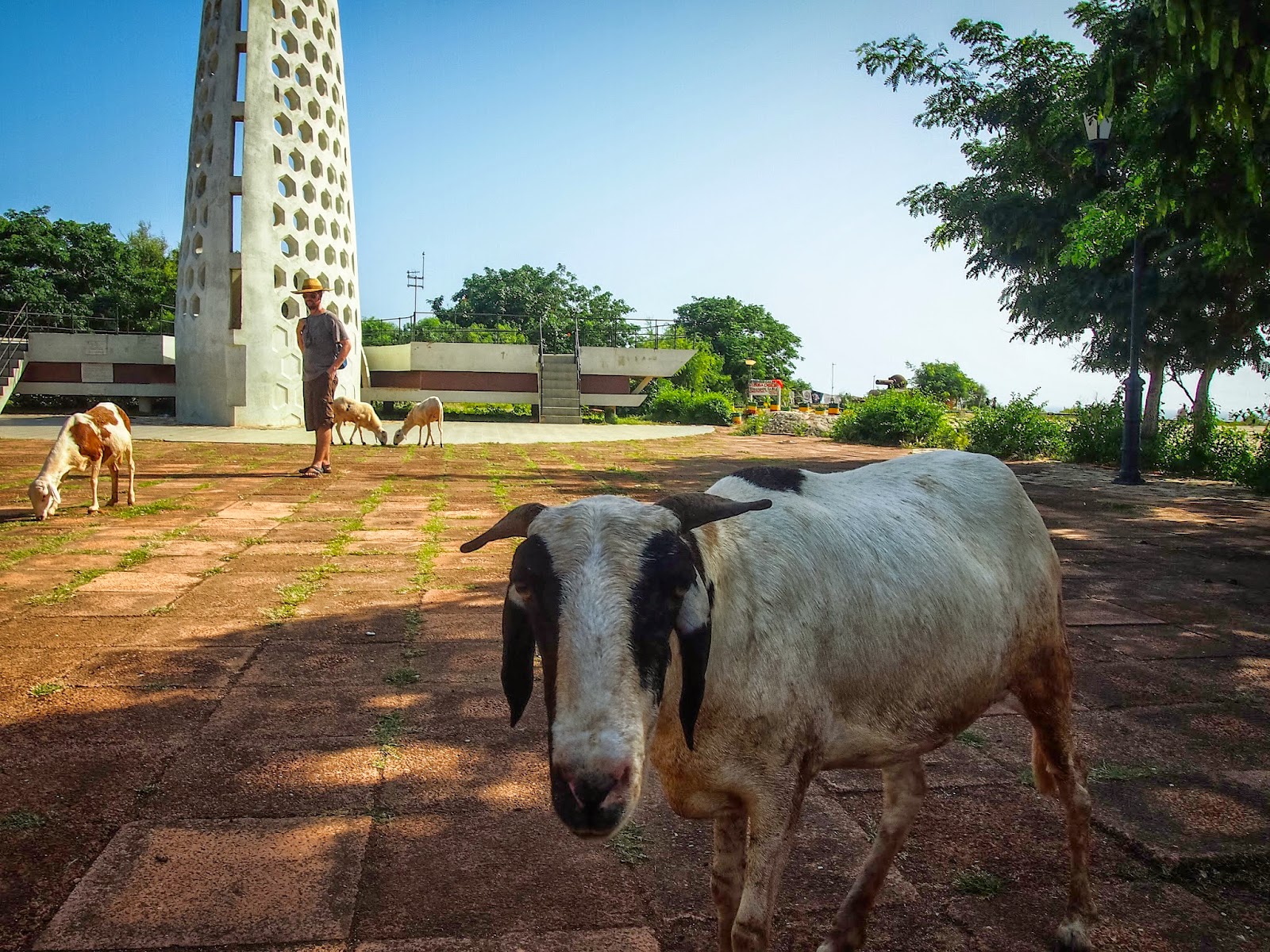


On our last afternoon in Dakar we decided to cheat a little and hired a guide and his car for the afternoon and caught some parts of the city we hadn't yet seen. I'm often quick to dismiss the value of having a good guide - if you can get a recommendation and a guide who speaks your own language, it's a great stress-free way to quickly get a feel for a new city, plus you get a specially-designated person to ask all of those burning questions you have about what you're seeing and experiencing.


We couldn't leave Dakar without seeing the Monument of African Renaissance. The monument is enormous, apparently the tallest statue in Africa and taller than the statue of liberty, and was massively controversial at the time of construction: for it's $27 million cost, its scantily-clad models, the gender implications, the role of North Korea in its construction, and the fact that the president planned to take a chop of the entrance fees (his defense was that he helped design it. Haha). Like most, we were content just to walk around it and not take an elevator up to the man's forehead.
Our final Dakar stop was to check out the most Western point on the African continent, Pointe des Almadies. By comparison to the African renaissance monument, this was much more in line with what we had come to expect from significant places in West Africa - more unsigned than simply understated, tucked behind a restaurant, a fishery and some art dealers.

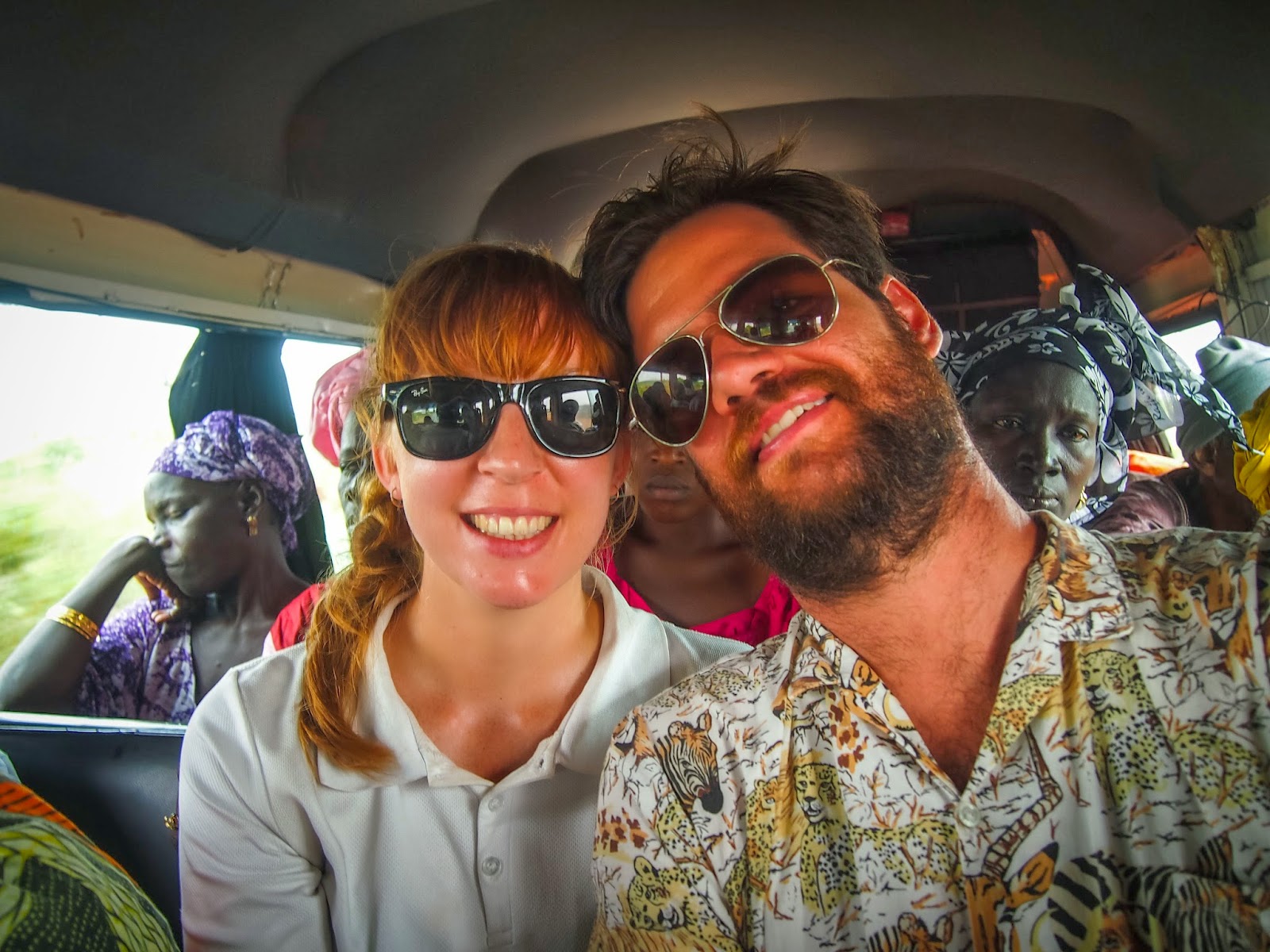
We then piled into a TroTro, and headed north to Saint Louis, the first place of settlement of the French in West Africa. After shelling out a pretty cfa for a great French breakfast in a cafe the first morning, we followed the locals the second morning and hit gold. First stop, the hole-in-the-wall-bakery selling fresh baguettes for next to nothing. Next , one of the mamas who had set up shop next door selling beans, eggs, and chilli to add to your baguette. And final stop, the nescafe cart, but not just for instant coffee, but Senegal's amazing Cafe Touba - like a short black with an insane amount of sugar and grounded with djar or selim pepper, making it something like a spicy, coffee version of chai. This my friends, is how Senegal should be done. We were kicking ourselves for wasting so many days doing breakfast any other way!
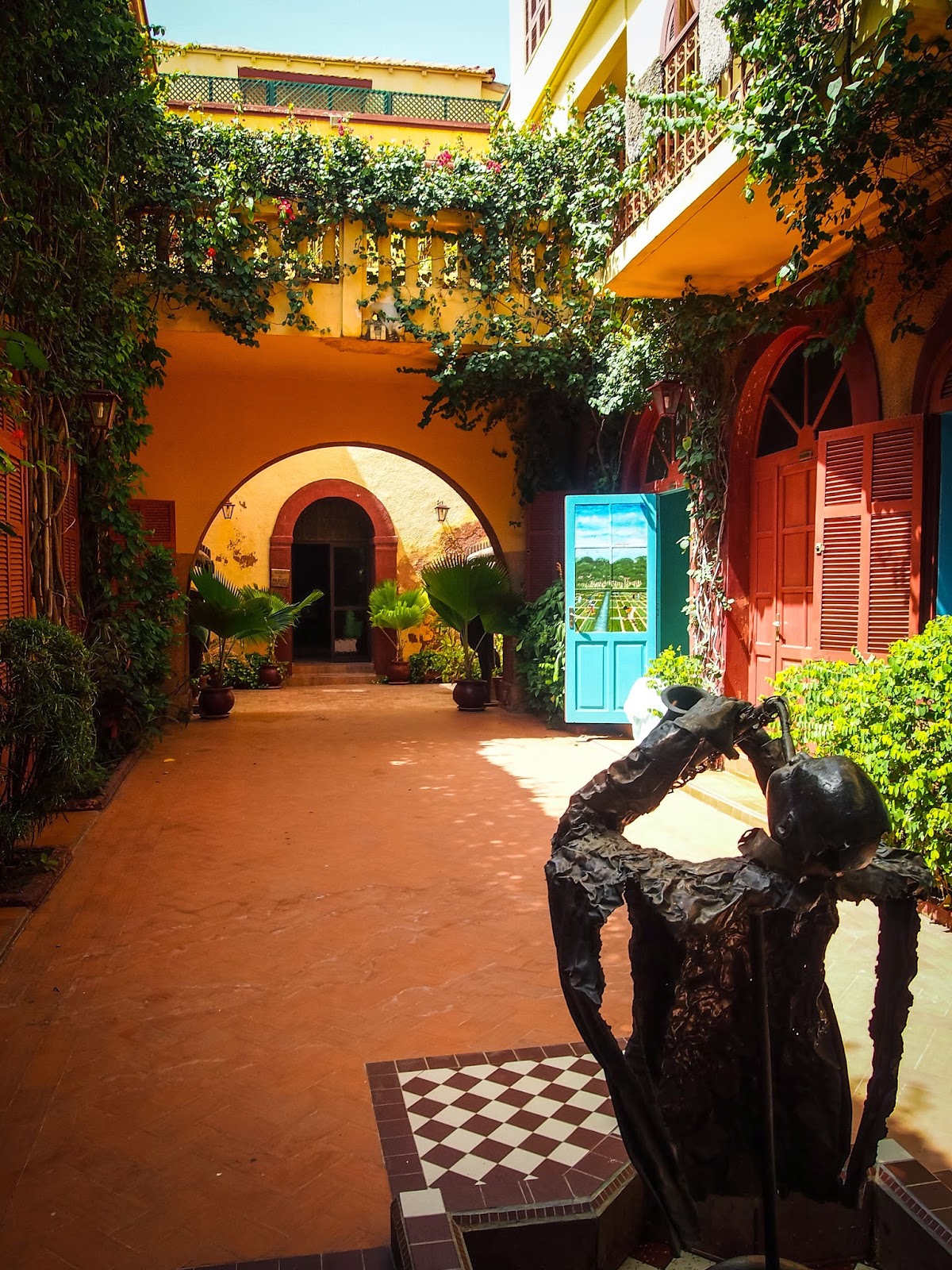
Saint Louis was the first French colonial settlement in West Africa, which is fairly clear in its crumbling French colonial architecture. Some buildings have been beautifully restored, others left in original forms. It's somewhat confusing though to walk around and be mesmerized by the beauty of buildings that are there only because of the oppression of colonialism...
The next day we headed out to Langue De Barbarie National Park, known for its rich ecosystem and temporary home of thousands of bird species as they migrate from Europe. Sadly, the area has changed dramatically for the worst in recent times. In an attempt to manage regular flooding in Saint Louis, a channel was cut through the peninsula to the beach to allow the Senegal River to flow more quickly. But as always, earth wins and soon the channel was kilometres wide, changing this freshwater ecosystem into a marine park.

I was most disappointed at not seeing pink flamingos close up (we did see spot some white babies on our way home) but that is hardly the worst of it. The change is destroying not only the ecosystem but the economies of the locals too as farmland became salinated. Before this happened, had already noted climate change was impacting on bird migration and salinty in the soils, and now this latest change has only worsened the situation, evidenced by abandoned field after abandoned field. It's still a beautiful park and well worth your time to check it out.

A bit more sight seeing, and a Galapagos tortoise in a hotel swimming pool area later, and we were almost ready to head home of Accra....


Our final stop on the way back to Dakar was one night in Lompoul Desert, which is actually a huge spread of sand dunes behind the coast line, forming what seems to be desert as far as the eye can see. It was incredibly peaceful, complete with Mauritanian tents...the perfect way to say goodbye to fascinating country I hope to spend more time in someday!


*Massive shout out to Madam Cassie who made these pictures possible because she kindly lent me her camera when mine was stolen a week or so before this trip! She is amazing!
Category Desert, Senegal, Travel, West Africa

Voyages Afrique de l'Ouest: Benin #3 A voodoo ceremony in Abomey
0Friday, 21 March 2014 by Renee
After our overnight stay in the Venice of Africa, we piled onto a moto, then squished into an overloaded trotro for an unprecedentedly long time, about 8 hours, to get from Ganvie, just north of Cotonou, to Abomey, in the centre of Benin. Cotonou and Abomey are two major centres that, like Accra to Kumasi in Ghana, you would imagine to be linked by at least a half decent road to faciliate movement of goods and services, but also like Accra to Kumasi, are actually linked by a road which is inexplicably terrible at best and barely even exists at its worst. Except, it turns out, not that inexplicable: as a tour guide explained to us, the majority of people in Abomey tend not to vote for the southern-based political party who holds power, thus they are punished by having to deal with a truly abysmal road. I don't usually get motion sickness, except on this road, where the pot holes were so deep and frequent that I felt like I was being thrashed about in a washing machine.

The upside of the bad roads was that at some parts the road was much too narrow for two lanes of traffic, so we actually had to stop and get out to wait for about two hours while the massive road trains coming down from Niger and Burkina Faso passed. We bought a fresh baguette off a market woman's head, a goat kebab off a bbq (you could tell that one was fresh from the goat's head sitting at the base of the bbq) and had the best sandwich we had eaten all year.
Eventually, we did make it to Abomey without our vehicle becoming one of the many casualties strewn on the side of the road. Abomey was the capital of the Dahomey Kingdom and stands as a living muesuem of that time which was the site of various wars including against the French. On the backs of motos with guides who we later discovered had definitely ripped us off, we soaked up the ancient feeling of the town, including the Route of Kings which takes you past various king's palaces, and walked through the world heritage site of the historical mueseum housed in the palaces of King Ghezo and Glele. We were struck at how similar it was to the Forbidden City in China, almost an identical, West African version. It was also a fairly brutal place in its day, some of the palaces were made of the sediment of sacred rivers and the crushed bones of 40 enemies, and one of the kings did some Tonia Toddman-style renovations to his throne, replacing the feet with the skulls of four enemies. The tour guide relished in telling us "these are the skulls of conquered enemy soldiers - they were Nigerians". Seriously, are there any West Africans who don't hate Nigerians?

Despite being located right next door to the oil superpower of Nigeria, this is what you can expect of a petrol station in Benin: a stand full of shake-your-own two stroke fuel, made up of bootleg petrol smuggled in from Nigeria. How this doesn't result in catastrophe more often is beyond me, but I guess you make do with what you can right?
 But what was the real highlight for us was our trip to the Voodoo temple, where we met with the Voodoo Priest who explained to us a lot about the various aspects of belief and tradition within voodoo. Quite a few people from home have asked what it was like seeing voodoo and traditional beliefs. There is a great conversation in Chinua Achebe's classic Things Fall Apart (which if you haven't read it, you must, it is an amazing illustration of West Africa) between a missionary and villager that highlights how various religions aren't so different after all. The missionary says: "You carve a piece of wood...and you call it a god. But it is still a piece of wood." 'Yes," said Akunna. "It is indeed a piece of wood, The tree from which it came was made by Chukwu (the supreme god), as indeed all minor gods were. But He made them for His messengers so that we could approach Him through them..."
When the tour of the voodoo temple came to the end, we were asked if we would like to do a small voodoo ceremony, say for love, health, maybe prosperity? Having been around for a while at this point, we double checked that this was free, and then had a quick discussion about what we should have a ceremony for. The topic of what on earth we would do when my assignment ended in Ghana had become a constant topic of conversation, so as a sort-of-joke-sort-of-desperation, we asked if we could do a ceremony for good jobs. Oh yes, they replied, that's an important ceremony, we can do that. A flurry of activity, some money required to buy some gin and palm oil, and possibly also one of the chickens running around and we were in the process of setting up our ceremony...


After the chicken and oil procurement had taken place, other elements, including large wooden fetishes were trotted out into a circle. Everything was all set up and then came the clincher, our tour guide translated, this is a very important ceremony he said, so actually, it's going to cost about CFA20,000 for each person. That's about $AUS40, and needless to say an awful lot of money in these parts. We were furious, but not at all suprised. We explained we didn't have that kind of money, not on us or elsewhere, and that we should have been told before all of the work was done to set it up. To get a good job is very important, and involves several fetishes, so the ceremony is expensive. Well, we couldn't afford good jobs then, we complained. We were told that the ceremonies initially suggested are much more simple, that's why they are free. Well then, we'll just ask for prosperity then - that's basically the same thing, right?
So off the good-job fetishes marched back into the storage, and out came the new prosperity ones. Luckily, the change of plan also meant a chicken's life would be saved. Phew. Finally, we were on....


It was, in classic West African style, an infuriating, hilarious, and insightful afternoon.
Category Benin, Travel, Voodoo, West Africa
